Analytical | Determined | Passionate | Team-Oriented.
My work is driven by a singular goal: to leverage my skills in machine learning, algorithms, and
hardware to become a world-class roboticist and create technology that positively impacts humanity.
Philadelphia, USA
Master's of Science in Engineering (Robotics) • May
2026
Singapore
Bachelor's in Computer Engineering • June 2021
Graduate Research Assistant • May 2025 - Present
C3, a leading research project from the DAIRLab, addresses the complex challenge of systems that make and break contact with their environment. The nonlinear dynamics of this problem pose a significant hurdle for traditional methods like MPC and sampling-based approaches. As the lead developer on the project's GitHub repository, I drove key initiatives to professionalize the codebase, with contributions including:
Robotics Software Engineer • Aug 2022 - Aug 2024
Eureka Robotics is a team of highly talented individuals
who have come together to create software and systems for high-accuracy, high-agility (HA-HA)
robotic tasks.
Through my role, I gained extensive experience in robotic systems
integration, by developing a comprehensive automation solution for industry
applications.
I led the development of a unified control framework built on C++ and
Python, with responsibilities that extended beyond software to include maintaining and deploying
hardware systems and ensuring the successful delivery of applications to clients.
My technical skills include:
Junior Embedded Engineer • July 2021 - Aug 2022
In this role, I was working as the sole embedded engineer on a team developing a
full-fledged Access Control System. This product required a versatile skill set
due to its diverse architecture, which included both legacy and modern components.
My responsibilities had been two-fold:
This dual role required me to handle a wide range of tasks, from interfacing a facial recognition service over a TCP/IP socket on Red Hat, Linux to replacing an outdated fingerprint recognition module via UART. This experience has prepared me to work effectively under pressure and deliver timely, reliable results, regardless of the challenge.
Software Engineering Intern• January 2020 — August 2020
My role during this internship included closely working with the testing team. We followed the agile methodology of software development and I made use of python frameworks such as PyTest, Selenium & Appium in order to automate the functionalities of a web application. My biggest takeaway from the internship is the power of a united and talented team all working towards a common goal.
Learning is one of my fondest interests. Thus, I am constantly on the lookout for new skills and projects to master them; Similar to how I used HTML & CSS for the first time to create this website 😄. Here's an analysis of my top skills:
Some other skills I have picked up along the way include
| Java | VPython | C# | TensorFlow | Torch | Bazel |
| goLang | Linux | OpenCV | NumPy | PyBind | Assembly |
| Firebase | CUDA C | Arduino | Scikit-learn | PyTest | Java |
| Bash | MATLAB | Drake | SciPy | GoogleTest | Vim |
This is a personal project with an objective to one day alow a 4-DOF bot to play chess. Currently, I am using the functionalities of ROS + the concept of configuration space in robotics to generate random target positions and guiding the robot towards that position.
ROS, Robotics, A* Algorithm
CUDA C is a framework used by Jetson GPUs in order to control and structure parallel threading. Using this framework, I took advantage of the computing power of the GPU to improve the processing speed of a basic Image Recognition technique i.e. Convolution. It's application includes autonomous vehicles for which reaction time is dependent on the processing of images.
CUDA C, Image RecognitionThe terpsitone is one of the first non-contact instruments created roughly 50 years ago. However, over the years popularity of the instrument has steadily declined due to lack of instruction and difficulty to play. I worked with Prof. Alexei Sourin from NTU to interface the widely available Kinect Sensor with an existing GUI to replicate the unique sound of a Terpsitone. This accompanied with various other features such as following an in-built song and multiple players are how we intended to bring the instrument back to life.
C#, Music, Terpsitone, ResearchThis was an 8-man project wherein our objective was to traverse and map a maze. I Led the hardware team to design an Arduino implemented bot responsive to algorithmic commands based on sensor data
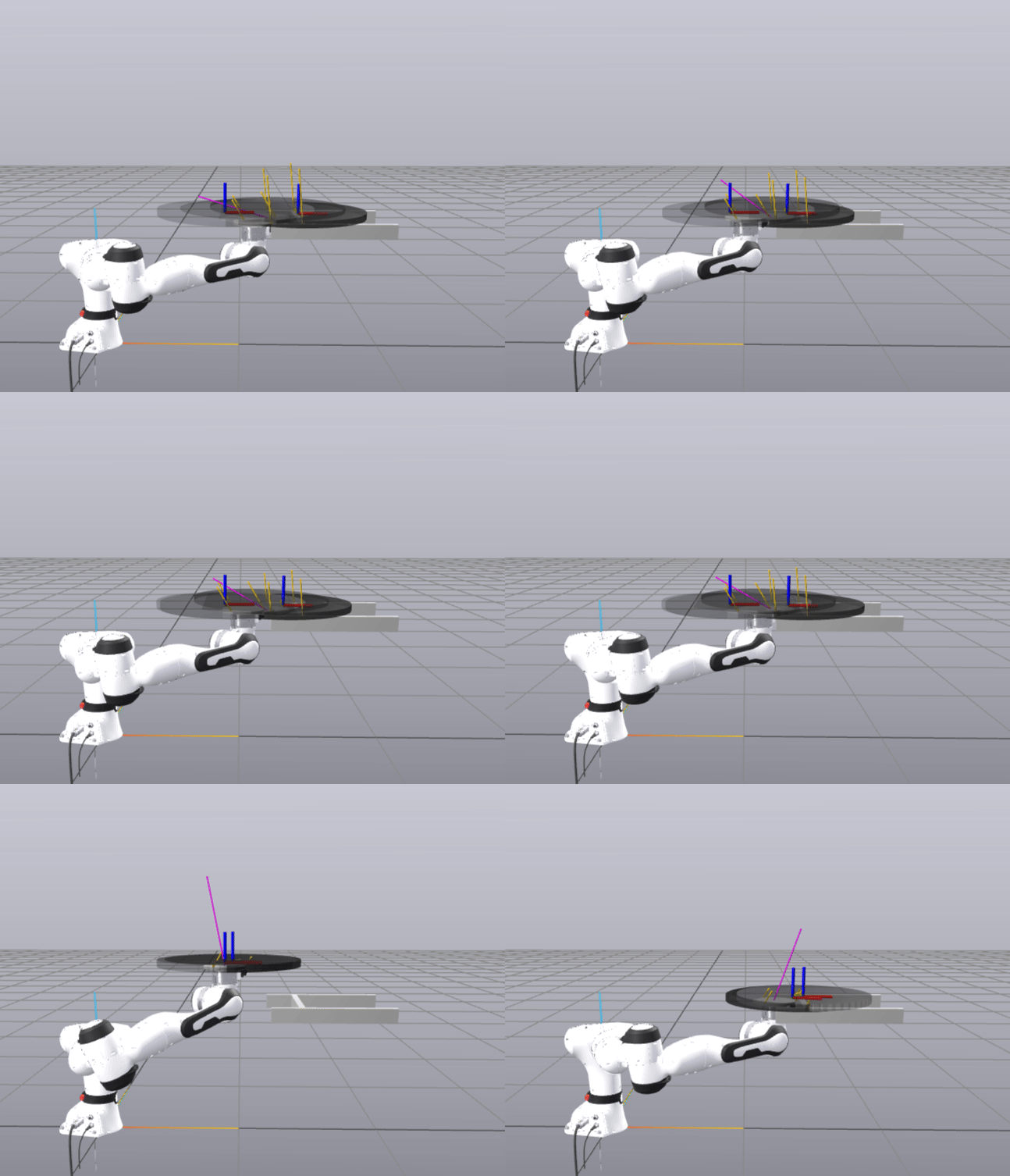
ArduinoThis project integrates Visual Inertial Odometry (VIO) with trajectory planning and control to achieve fully autonomous quadcopter flight. The key challenge? Making the drone navigate using only its own state estimates instead of ground-truth data. We developed and tested everything in the flightsim environment, creating a closed-loop system that flies based purely on onboard sensing, bringing us one step closer to real-world autonomous flight. Minor hardware tests were also conducted as proof of concept.
Python, Robotics, VIO, ROS, A*This project tackles the classic but challenging problem of balancing an inverted pendulum atop a flying quadrotor; a highly nonlinear system combining aerial dynamics with unstable pendulum motion. We employed Model Predictive Control (MPC) to track dynamically-generated trajectories from Direct Collocation, while using RRT* for collision-free path planning in obstacle-rich environments.
Python, Robotics, Drake, Optimization, MPCThis project explores end-to-end autonomous drone racing using Proximal Policy Optimization (PPO) in NVIDIA Isaac Sim. We trained a quadrotor agent to navigate through complex racing gates while avoiding obstacles, using vision-based input and reward shaping to encourage aggressive yet stable flight. The result demonstrates the potential of deep reinforcement learning for high-speed robotic navigation tasks.
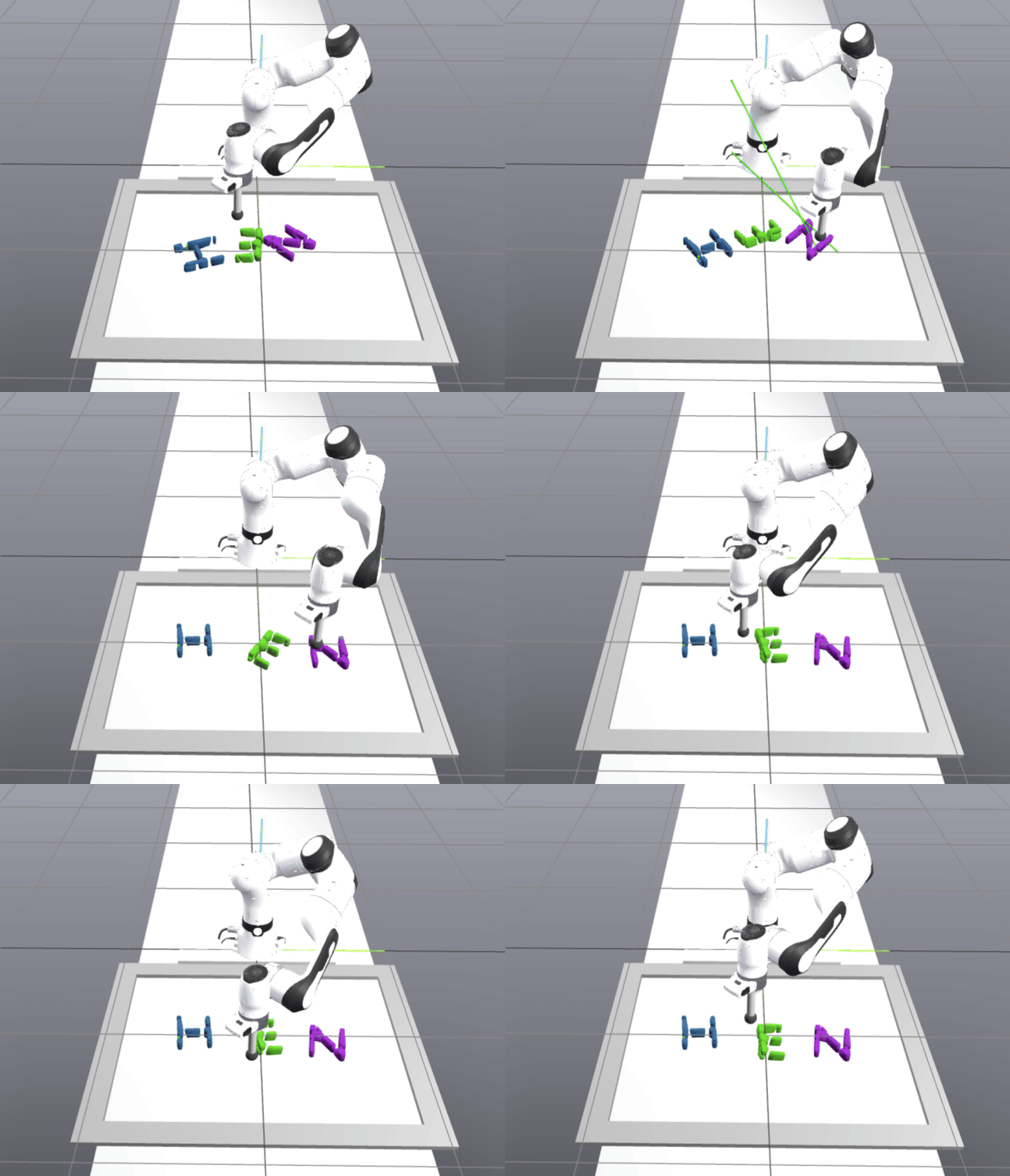
PPO, Robotics, Python, IsaacSimThis project was completed as part of the Introduction to Robotics course, where we competed to stack cubes autonomously using a robotic manipulator. The challenge involved precise inverse kinematics, path planning, and real-time perception to detect and grasp cubes, then stack them in the correct order. Our team successfully implemented a robust pipeline that combined computer vision, motion planning, and control to complete the task efficiently under time constraints.
Robotics, Python, ROS, Forward and Inverse KinematicsSpending the first 18 years of my life in Kuwait, I have witnessed first hand the effect of global warming. The steady increase of temperature every year approximating 50 degrees celsius makes it very difficult to live. It falls upon us, the inheriters and tenants of the earth to make a small change so as to create a big impact.
Sed ut perspiciatis unde omnis iste natus error sit voluptatem accusantium doloremque laudantium, totam rem aperiam, eaque ipsa quae ab illo inventore veritatis et quasi architecto beatae vitae dicta sunt explicabo. Nemo enim ipsam voluptatem quia voluptas sit aspernatur aut odit aut fugit.